نشر مقالة علمية للتدريسي في جامعة المستقبل - كلية الهندسة - مــــقرر قسم هندسة تقنيات الحاسوب د ((مياس محمد مهدي))بعنوان ((what is cluster computing))
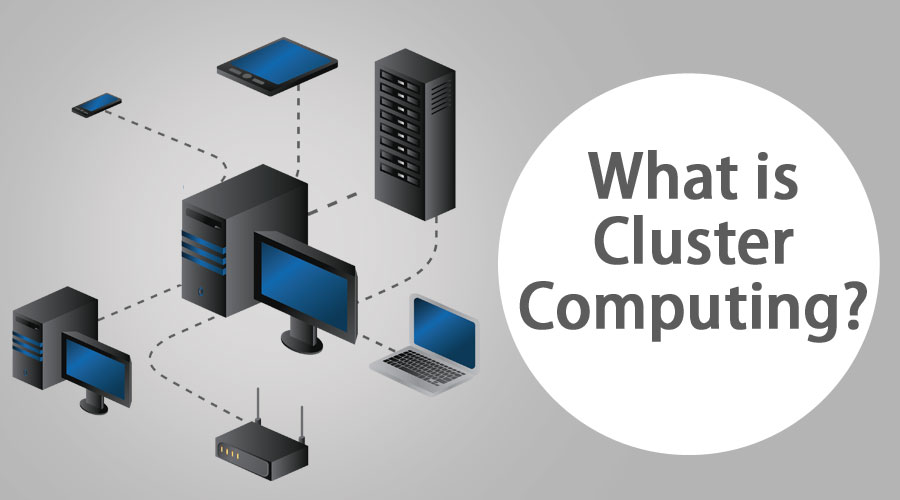
What is Cluster Computing:<br /><br />Cluster computing is a collection of tightly or loosely connected computers that work together so that they act as a single entity. The connected computers execute operations all together thus creating the idea of a single system. The clusters are generally connected through fast local area networks (LANs)<br /> <br /> <br />Cluster Computing<br />Why is Cluster Computing important?<br />1. Cluster computing gives a relatively inexpensive, unconventional to the large server or mainframe computer solutions.<br />2. It resolves the demand for content criticality and process services in a faster way.<br />3. Many organizations and IT companies are implementing cluster computing to augment their scalability, availability, processing speed and resource management at economic prices.<br />4. It ensures that computational power is always available.<br />5. It provides a single general strategy for the implementation and application of parallel high-performance systems independent of certain hardware vendors and their product decisions.<br /> <br /> <br />A Simple Cluster Computing Layout<br />Types of Cluster computing :<br />1. High performance (HP) clusters :<br />HP clusters use computer clusters and supercomputers to solve advance computational problems. They are used to performing functions that need nodes to communicate as they perform their jobs. They are designed to take benefit of the parallel processing power of several nodes.<br />2. Load-balancing clusters :<br />Incoming requests are distributed for resources among several nodes running similar programs or having similar content. This prevents any single node from receiving a disproportionate amount of task. This type of distribution is generally used in a web-hosting environment.<br />3. High Availability (HA) Clusters :<br />HA clusters are designed to maintain redundant nodes that can act as backup systems in case any failure occurs. Consistent computing services like business activities, complicated databases, customer services like e-websites and network file distribution are provided. They are designed to give uninterrupted data availability to the customers. <br />Classification of Cluster :<br /> <br />1. Open Cluster :<br />IPs are needed by every node and those are accessed only through the internet or web. This type of cluster causes enhanced security concerns.<br />2. Close Cluster :<br />The nodes are hidden behind the gateway node, and they provide increased protection. They need fewer IP addresses and are good for computational tasks. <br />Cluster Computing Architecture :<br />• It is designed with an array of interconnected individual computers and the computer systems operating collectively as a single standalone system.<br />• It is a group of workstations or computers working together as a single, integrated computing resource connected via high speed interconnects.<br />• A node – Either a single or a multiprocessor network having memory, input and output functions and an operating system.<br />• Two or more nodes are connected on a single line or every node might be connected individually through a LAN connection.<br /> <br /> <br />Cluster Computing Architecture<br />Components of a Cluster Computer :<br />1. Cluster Nodes<br />2. Cluster Operating System<br />3. The switch or node interconnect<br />4. Network switching hardware<br /> <br />Cluster Components<br />Advantages of Cluster Computing :<br /> <br />1. High Performance : <br />The systems offer better and enhanced performance than that of mainframe computer networks.<br />2. Easy to manage :<br />Cluster Computing is manageable and easy to implement.<br />3. Scalable :<br />Resources can be added to the clusters accordingly.<br />4. Expandability :<br />Computer clusters can be expanded easily by adding additional computers to the network. Cluster computing is capable of combining several additional resources or the networks to the existing computer system.<br />5. Availability :<br />The other nodes will be active when one node gets failed and will function as a proxy for the failed node. This makes sure for enhanced availability.<br />6. Flexibility :<br />It can be upgraded to the superior specification or additional nodes can be added.<br />Disadvantages of Cluster Computing :<br /> <br />1. High cost :<br />It is not so much cost-effective due to its high hardware and its design.<br />2. Problem in finding fault :<br />It is difficult to find which component has a fault.<br />3. More space is needed :<br />Infrastructure may increase as more servers are needed to manage and monitor. <br />Applications of Cluster Computing :<br />• Various complex computational problems can be solved.<br />• It can be used in the applications of aerodynamics, astrophysics and in data mining.<br />• Weather forecasting.<br />• Image Rendering.<br />• Various e-commerce applications.<br />• Earthquake Simulation.<br />• Petroleum reservoir simulation.<br /><br />