





Diagnosis & Treatment Evolution of Children Suffering from Diabetic Ketoacidosis with Severe Pancreatitis
05/04/2022 Share :
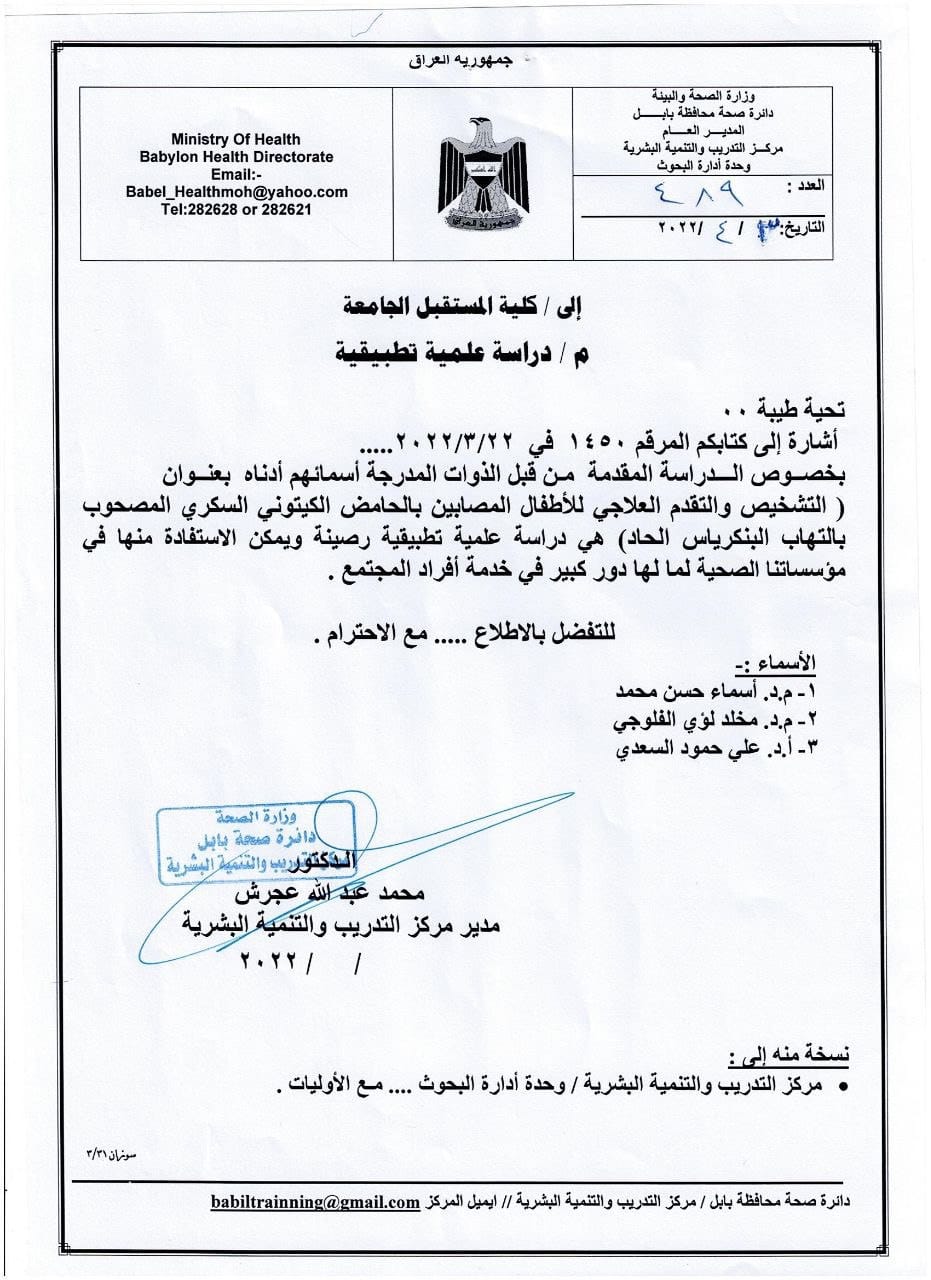
Being in line with the achievement of SDG_03, and for the purpose of reducing infant mortality as well as curtailing the deaths resulting from non-communicable diseases, a joint applied scientific study has been submitted by Dr. Asmaa Hassan Muhammad, the rapporteur of Radiology Techniques Department, in conjunction with Dr. Mukhalld Louai Al-Fallouji, the Deputy Head of Dentistry Department and Prof. Dr. Ali Hamoud Al-Saadi, College of Sciences, University of Babylon. The study is under the title
“Diagnosis & Treatment Evolution of Children Suffering from Diabetic Ketoacidosis with Severe Pancreatitis”
It should be taken into account that the rate of type 01 diabetes among children has been steadily increasing all over the world, and more than a third of the affected children often suffer from diabetic ketoacidosis complications. It is indeed considered as a main reason for death among children. Symptoms of diabetic ketoacidosis include nausea, vomiting, abdominal pain, and an acetone-like smell when breathing.
However, diabetic ketoacidosis could be regarded sometimes as a sign that the child is having diabetes. In fact, cerebral edema and severe pancreatitis are deemed to be the most serious complications of diabetic ketoacidosis. Accordingly, lots of extensive research have been conducted to obtain effective therapeutic measures not only for cerebral edema, but also to find remedial methods for eliminating hyper-coagulable cases that lead to stroke, deep vein thrombosis, pulmonary and gastrointestinal complications, in addition to long-term memory impairment.
In general, the study has focused on the most important methods utilized for diagnosis, such as urine and blood tests in order to determine the levels of ketones and acid that could be the reason for the presence of high levels of glucose in the blood.
Finally, this study recommends that chest x-rays shall be executed, in addition to urine test so as to detect the presence of latent infection. Moreover, electrocardiography shall be conducted as a procedure for early disclosure of heart attacks.