




A New Scientific Research Published by Dr. Riyadh Abdul Abbas Ali Al-Sultani, an Academic at the Department of Building & Construction Engineering in the International Journal of Concrete Structures & Materials
23/01/2023 Share :
It is considerable to note that Dr. Riyadh Abdul Abbas Ali Al-Sultani, an Academic at the Department of Building & Construction Engineering, has recently published a new Scientific Research entitled
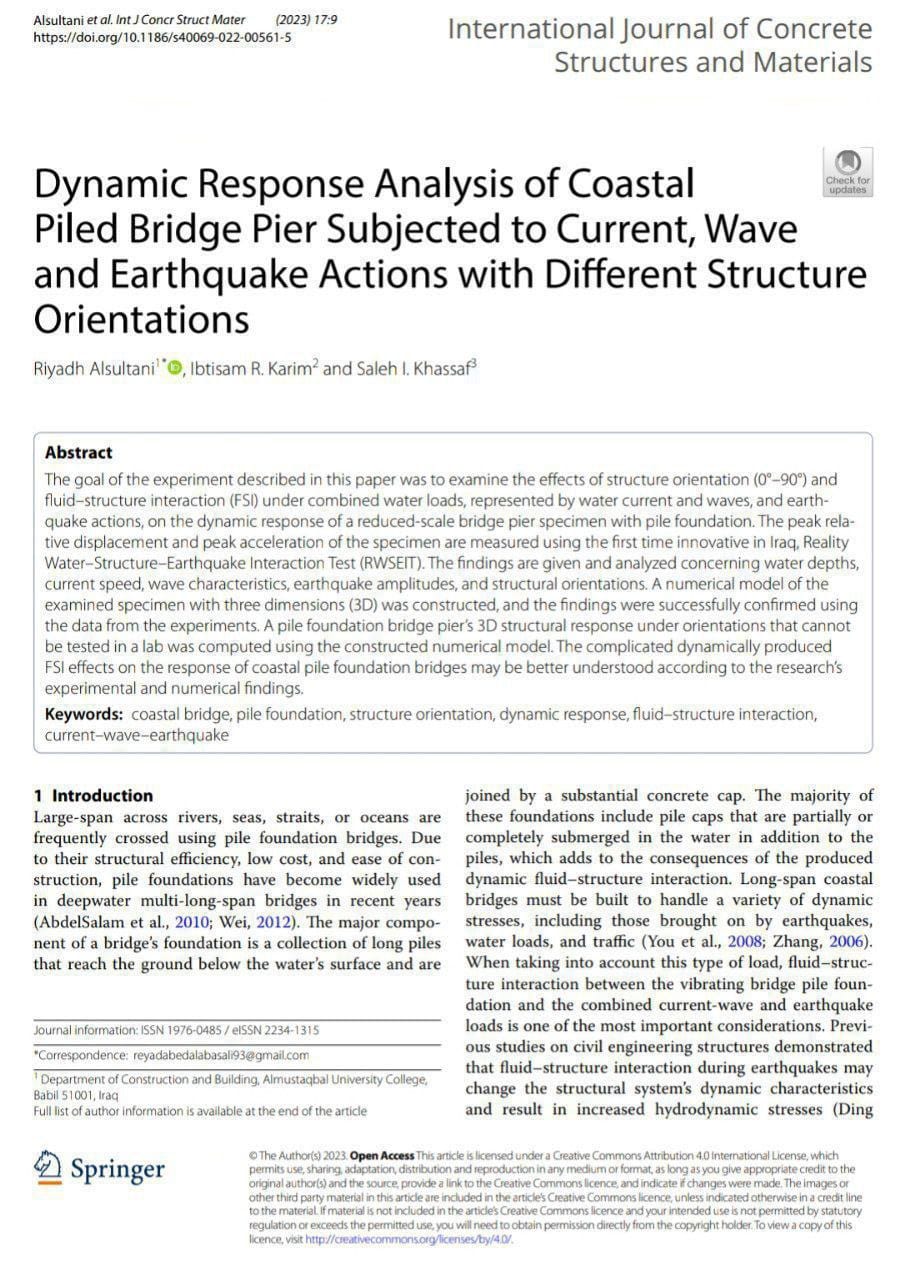
“Dynamic Response Analysis of Coastal Piled Bridge Pier Subjected to Current, Wave and Earthquake Actions with Different Structure Orientations”
We should note as well that this distinguished research has been accomplished in cooperation with Prof Dr. Ibtisam Rahim Karim / University of Technology, and Prof Dr. Salih Esa Khassaf / University of Basrah. It has been published in the “International Journal of Concrete Structures & Materials”, which is issued in the USA by the Publisher Springer Nature, and indexed as one of the Q1 SCOPUS & Clarivate Engines, with Impact Factor 3.24 and Site Score 5.2.
The research has been dealing with the effect of the structures direction (bridges) under the influence of water forces represented by water currents and waves combined with seismic forces on the dynamic response of the pillars of marine bridges with a pile foundation, taking into consideration the displacement and acceleration of the laboratory sample that has been measured by using a smart laboratory system capable of modelling the real coupling between hydrodynamic forces, structures and seismic forces . The results have been submitted and analyzed with respect to water depths, current velocity, wave characteristics, seismic force accelerations, and different structural trends.
In addition, a three-dimensional numerical model has been created for the laboratory sample in order to verify the results of practical experiments, as well as to calculate the structural response under the influence of angles that cannot be examined in the laboratory where the results have proved that the effect of the direction of origin cannot be neglected in the design of hydraulic installations, especially with Marine Bridges, and that the largest effect has been found when the origin is in a transverse direction with the effective forces of different variations.
To review the Research, you may visit the Link given below:
https://ijcsm.springeropen.com/.../10.../s40069-022-00561-5